

1688 Sourcing Agent vs Alibaba: Which Is Better? It Depends on One Number
The question is usually framed wrong. “1688 sourcing agent vs Alibaba” sounds like a choice between two competing marketplaces. It isn’t.
Alibaba is a self-service export marketplace you navigate yourself. A 1688 sourcing agent is a China-based execution partner who buys from a different marketplace—1688, Alibaba Group’s domestic wholesale platform—on your behalf. Comparing them directly is like comparing a retail store to a personal shopper who has access to the wholesale back room.
The real question is: at your current order size, does the factory-direct price on 1688 survive the agent’s fee and the extra friction? For most buyers, one number settles it—and that number is not the headline price on either platform.
The price gap is real, and it is large
The same factory that quotes you $1.80 on Alibaba often sells the identical item on 1688 for the equivalent of $0.58—a gap of nearly 70%. Broader comparisons put the typical 1688 discount at 5–15% below Alibaba after accounting for product mix, and some sourcing firms report 20–40% on comparable SKUs.
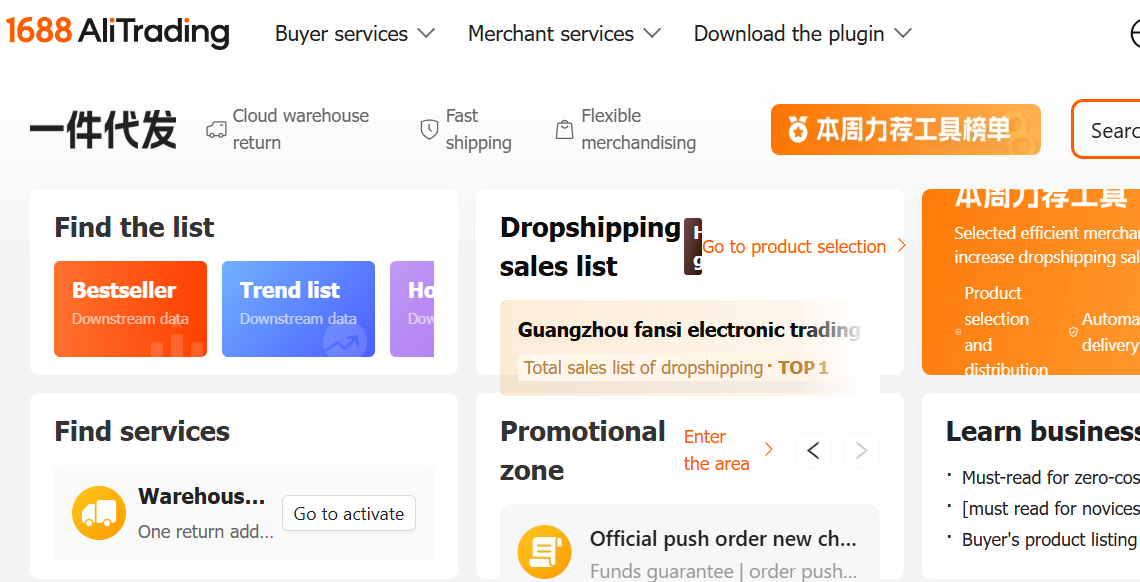
The reason is structural, not negotiable. Alibaba sellers build export handling, English-speaking staff, international marketing, and platform fees into their quotes. 1688 is a domestic Chinese platform: prices are in RMB, listings are Chinese-only, and most sellers ship only within mainland China. What you see is closer to the true factory-gate price, without the “export markup” layered on top.
But that lower price comes with a gate. 1688 has no Trade Assurance equivalent for foreign buyers, runs almost entirely on Alipay and domestic Chinese payment methods, and rarely ships internationally. To access it from outside China, you need an agent—and the agent charges for that access.
What the agent actually costs—and what it actually buys
Agent fees typically run 3–10% of order value, or a flat fee with a minimum. The structure varies more than the headline percentage suggests.
A representative tiered model looks like this: **10% on orders below $1,000** (with a $50 minimum, so a $300 order still costs $50), 8% from $1,000 to $5,000, 6.5% from $5,000 to $10,000, and **5% above $10,000**. Some agents use flat per-order fees instead—$30–$100 is common on smaller orders—while others blend a lower commission with per-SKU handling charges.
The fee buys more than payment processing. A competent agent receives goods at a China warehouse, checks quantity and visible condition against the listing, consolidates multiple suppliers into one international shipment, and handles export paperwork. That consolidation matters: five separate supplier parcels shipped internationally can cost far more than one consolidated carton, and domestic shipping within China to a single warehouse is cheap—often ¥20 or less per parcel.
Here is where the math turns. A $20,000 order through an Alibaba trading company might cost $20,000 in product plus $300 for third-party inspection, with consolidation extra. The same order through a sourcing agent at factory-direct 1688 pricing might cost $15,500 in product plus a 7% commission ($1,085), with inspection and consolidation included—**$16,585 total before freight**, versus $20,300+ on the Alibaba route. At that scale, the agent fee is not a cost. It is the cheaper option by a wide margin.
Where the math flips: the small-order trap
The 1688 advantage is not linear. On small orders, agent economics work against you.
Below roughly **$2,000 in order value**, the agent fee and minimum charges frequently wipe out the factory-direct savings. One sourcing firm puts the break-even even higher for certain categories: below **300 units**, agent fees can eliminate the 1688 price gap entirely. A $500 test order might carry a $50 minimum fee before the agent has done anything beyond placing the order—10% of the goods value before international freight, inspection add-ons, or payment processing are counted.
Alibaba, by contrast, has no service fee for buyers. Its costs are baked into the quoted price, and Trade Assurance holds your payment in escrow until you confirm the order meets agreed terms—a genuine protection on a first order with an unproven supplier. On a small trial, that protection and the absence of a separate fee often make Alibaba the cheaper route on a landed-cost basis, even though the unit price looks higher.
This is the number that matters: not the platform price, but the total cost to get conforming goods into your hands. Below the threshold, Alibaba’s “expensive convenience” is cheaper. Above it, the agent’s visible fee is less costly than Alibaba’s invisible markup.
The hidden risk that changes the comparison
There is a third cost that neither platform displays: the agent’s incentive structure.A 5% commission sounds transparent.
But some agents earn an undisclosed factory kickback—a rebate from the supplier, typically 3–10% of order value, on top of the commission you agreed to. In the worst cases, the supplier who pays the largest kickback wins your order, and your effective unit price is inflated by 30–40% while the agent insists they only took 5%.
This is not an argument against agents. It is an argument for auditing the fee model, not just the percentage. An agent who discloses factory invoices and refuses supplier rebates is worth a higher headline fee than a “cheap” agent whose real income is hidden in the product price. Ask directly: Do you accept any payment from the factory side? Can I see the factory invoice at the price you paid? An agent who cannot answer those questions clearly is not saving you money—they are repricing your goods.
A decision framework that fits actual orders
The choice is not ideological. It follows order size, product type, and what you are trying to learn.
Use Alibaba when:
1.Your order is under roughly $2,000–$3,000 and the product is standard or off-the-shelf.
2.You are testing a new product and need Trade Assurance to protect a first payment.
3.You need English communication, export documentation, and a supplier set up to ship internationally without extra coordination.
Use a 1688 sourcing agent when:
1.Your order is above roughly $10,000, where factory-direct pricing beats Alibaba even after a 5–10% commission.
2.You are buying multiple SKUs from multiple suppliers and want one consolidated shipment instead of five separate freight bills.
3.You are scaling a product that has already been validated, and every percentage point of unit cost matters for margin.
4.You need in-person quality inspection before goods leave China—something Alibaba’s marketplace model does not perform for you.
For many importers, the answer is both, in sequence: start on Alibaba to validate the product and supplier relationship with limited risk, then move the proven SKU to a 1688 agent once volume justifies the fee. Cross-reference the same item on 1688 even while buying on Alibaba—the domestic price gives you a negotiating benchmark and tells you how much room the Alibaba supplier has.
The takeaway
“1688 sourcing agent vs Alibaba” is not a winner-takes-all comparison. It is a threshold question.
Alibaba sells you access and protection at a bundled price. A 1688 agent sells you factory-direct pricing and execution at a visible fee, plus a hidden risk you must actively manage. Neither is universally cheaper. The agent wins when the order is large enough, the SKU mix complex enough, or the quality risk high enough that the fee is smaller than the markup it replaces. Alibaba wins when the order is small, the product unproven, or your tolerance for coordination is low.
The buyers who get this wrong are the ones who compare the two headline prices and stop there. The ones who get it right compare landed cost after fees, inspection, consolidation, and freight—and then choose the structure that matches the order in front of them, not the one that sounds cheaper in a screenshot.